Mapping Bankroll Erosion Patterns Across Progressive Betting Sequences in Multi-Game Casino Sessions
Frankie Hansen · Aug 11, 2026

Analysts in the gaming sector have documented how bankroll erosion unfolds when players apply progressive betting methods across extended sessions that combine roulette, blackjack, and slot machines, with data compiled through August 2026 from regulatory filings in multiple jurisdictions showing consistent patterns of capital reduction tied to sequence length and stake escalation rules. Observers note that progressive systems such as Martingale or Paroli require players to adjust wagers after each outcome, and when these adjustments span several game types the cumulative effect on available funds becomes measurable through session logs maintained by operators, while researchers at institutions like the University of Nevada Las Vegas have compiled datasets that illustrate how initial bankrolls shrink at varying rates depending on win streaks, loss sequences, and game volatility levels. Studies from the Australian Gambling Research Centre indicate that sessions exceeding three hours often reveal distinct erosion phases, with early stages showing modest dips from standard bet sizes and later stages accelerating once progressive multipliers activate, and these findings align with transaction records from licensed venues in Nevada where multi-game play occurs within single visits.Sequence Mapping Techniques in Progressive Structures
Those who track betting sequences divide them into discrete segments based on bet progression triggers, such as doubling after losses or increasing after wins, and data from operator reports demonstrate that erosion accelerates when players switch from low-volatility table games to high-volatility slots mid-sequence, since payout intervals differ sharply between these formats and force more frequent stake adjustments.
Mapping tools developed by industry analysts use time-stamped transaction data to plot fund levels against bet multipliers, revealing plateaus during short winning runs and steep declines when losses cluster, while figures from Canadian provincial gaming authorities highlight that sessions incorporating both even-money bets and side wagers produce more fragmented erosion curves than single-game formats.
Cross-Game Transition Effects on Capital Levels
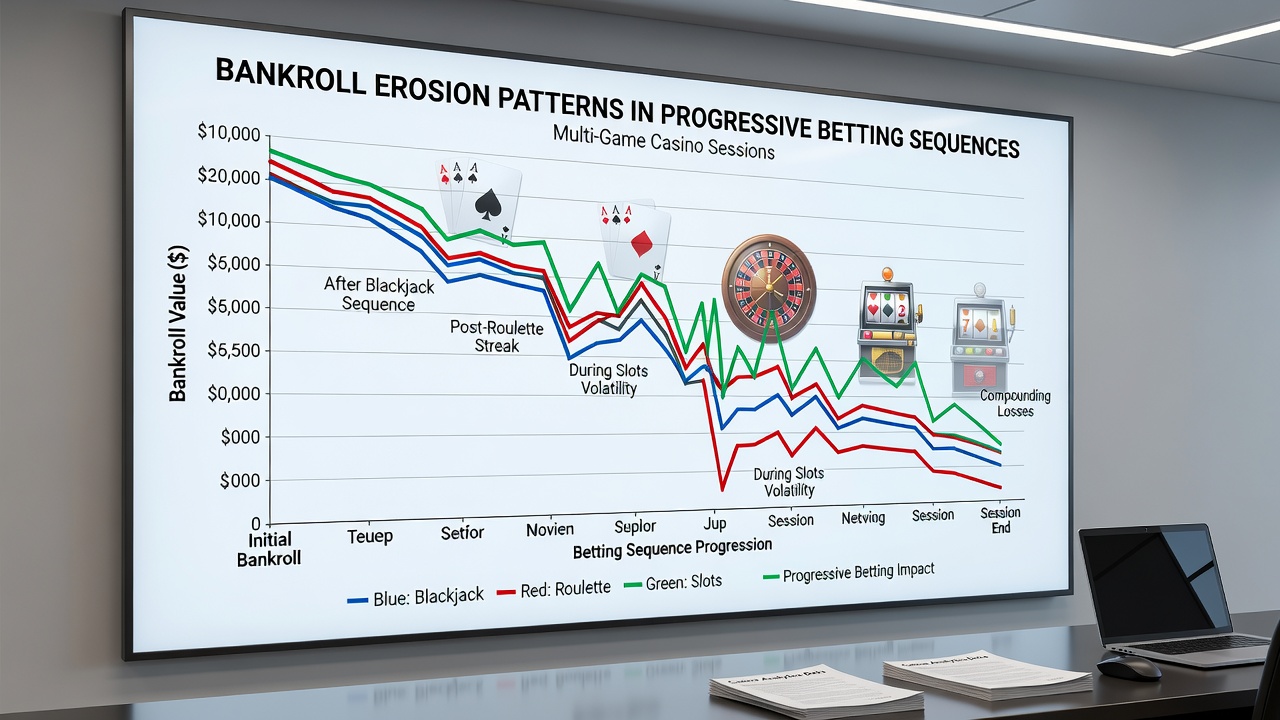
Transitions between games introduce additional variables because each title carries distinct house edges and payout frequencies, and evidence from Nevada Gaming Control Board summaries shows that players who move from blackjack progressions into slot sequences experience quicker drawdowns when bonus features fail to trigger within expected intervals.
Session records indicate that a progression started on roulette even-money bets may reach higher stake levels before a game switch occurs, at which point the new game's mechanics reset the sequence logic and alter the erosion slope, whereas aggregated data from multiple venues reveal that sessions with four or more game changes display more irregular capital depletion patterns than those with fewer switches.
Data Patterns from Regulatory and Academic Sources
Reports compiled through mid-2026 by the Nevada Gaming Control Board document average bankroll reductions of 18 to 27 percent in sessions lasting over four hours when progressive sequences span multiple titles, and similar patterns appear in academic papers from the University of Macau that examine Asian casino environments where multi-game play is common.
These datasets allow researchers to construct erosion maps that correlate bet progression depth with remaining capital, and analysts observe that sequences interrupted by table minimum adjustments or machine resets produce stepped rather than smooth decline lines, while cross-referenced figures from European gaming associations confirm that loss clustering in one game type often carries over to the next when progressive rules remain active.
Practical Applications of Erosion Mapping
Operators apply these maps to set session monitoring thresholds, using real-time data feeds to flag accounts where progressive sequences align with rapid fund reduction, and industry organizations note that such monitoring aligns with broader responsible gaming frameworks without restricting play mechanics.
Academic models further refine these maps by incorporating probability distributions for each game type, enabling predictions of capital thresholds at which sequences typically exhaust available funds, and records from licensed venues illustrate how players who maintain flat segments between progressions exhibit slower overall erosion compared with continuous escalation across game switches.
Conclusion
Mapping exercises continue to evolve as transaction volumes grow and analytical tools improve, with data through August 2026 providing clearer baselines for understanding how progressive betting sequences interact with multi-game structures to shape bankroll trajectories, and ongoing compilations from regulatory bodies and research centers supply the raw figures needed for these analyses.